


Who We Are
WARR Rocketry started as the first branch of WARR back in 1960. From a humble student group of less than 10 students, we have grown massively over the years to 150+ active members (in Rocketry alone, with 650+ in General) from all backgrounds up until today – from Aerospace and Mechanical Engineering to Economics and Business majors. The team consists of students in all Bachelor’s and Master’s semesters working alongside each other.

What We Do
At WARR Rocketry we develop, construct and launch advanced sounding rockets. From the engine and structure to the aerodynamic elements and the flight computer, we design the vast majority of the components ourselves. Leveraging years of expertise, we succeed at producing and testing our rockets with precision and innovation. Explore the heights with us as we redefine the frontiers of rocketry.
Current and Recent Projects

| Project Duration | 2024 – today |
| Height | ~3,5 m |
| Diameter | 90 cm |
| Cycle | Pressure-fed |
| Takeoff Mass | ~365 kg |
| Thrust | 4 kN |
| Landing hop altitude | 50 m |
| Propellant | Ethanol / LOX |
Retrofire
With Project Retrofire, a new chapter is starting to unfold in WARR’s long and successful story of student-engineered rocketry. Driven by the rise of reusable rockets, WARR is engineering its own propulsive lander – a pivotal milestone in reusable rocketry. Project Retrofire represents a fundamental leap forward in active flight control and deepens our understanding of thruster control, Thrust Vector Control (TVC), and Reaction Control Systems (RCS).
At its core, the project aims to develop a rocket capable of autonomous propulsive landing, building WARR’s expertise in engine throttling and flight control systems. Above all, it remains true to WARR’s mission: providing students from diverse fields with hands-on experience in reusable rocketry — right in the heart of Europe.
With this “rocket hopper”, WARR will enter the Collegiate Propulsive Lander Challenge, where university teams from around the world compete to perform a 50-meter free flight hop and tackle a series of demanding control maneuvers. So far, no team has completed them all — the race is still wide open. But beyond that, it also represents a crucial step in European Rocketry, as there currently is no propulsive lander in the European Union.
The final rocket will be powered by a pressure-fed bi-liquid engine (ethanol and liquid oxygen) delivering up to 4 kN of thrust. It will feature thrust vector control (TVC) for pitch and yaw and a cold-gas RCS for roll.
In parallel, a scaled-down electric prototype – as seen on the right – will allow rapid, cost-effective testing of control software and strategies. The EHopper is powered by a dual-rotor system to simulate both a single thrust vector and rotation. It runs the same controller and software as the pressure-fed rocket will, allowing easy testing and adaptation.
Be part of the next leap in student space exploration. Follow our development journey, explore sponsorship opportunities, or join our team at the next Kickoff.


Nixus
Project Nixus opened up a new chapter for WARR Rocketry, as we took on the challenge of building a bipropellant-liquid sounding rocket in 2020.
Reaching a height of 3,000 m as precisely as possible — the target that first allowed us to compete internationally — was our original goal. Since then, our ambition has grown: today, Project Nixus is focused on pushing the boundaries of what is technologically possible in student rocketry. To do so, we make use of cutting-edge technology, such as a 3D printed regeneratively cooled combustion chamber, as well as pressurization tanks made from CFRP. Moreover, we benefit from years of experience in working with cryogenic propellants and strong collaborations from industry and research.
The complexity of our rocket Nixus became clear during our first participation in the European Rocketry Challenge in October 2023, when we won the EuRoC New Space Design Award 2023. This award honors the team with the overall best design implementation, which displays a high competency in all its characteristics, is based on stringent strategic decisions, represents an exceptional challenge to realize, and might even go beyond pure rocketry to put special attention towards its innovation and/or payload.
At EuRoC 2024, Project Nixus successfully launched our rocket EX-4B, reaching an apogee of 1,678 m (AGL). The launch of this cryogenic bi-liquid rocket also marks the first launch of such a rocket in European student rocketry. We managed to win not only the L3 award, for the best liquid rocket with a target apogee of 3,000 m, but also the Team award, while our partner team Spacelabs won the Payload award for D.I.N.O.labs, which successfully collected data during our flight.
At EuRoC 2025, our follow-up rocket EX-4C was a strong contender that — were it not for problems with the electrical regulations (e-regs) — would have had a good chance at the L9 award.
Looking ahead, Project Nixus has been accepted for EuRoC 2026, where we are taking on our most ambitious challenge yet: reaching our 3,000 m target with a pump-fed rocket. Moving from a pressure-fed to a pump-fed engine cycle is a major step — instead of relying on heavy high-pressure tanks to drive the propellants, a dedicated pump feeds them into the combustion chamber, allowing for lighter tankage and higher performance. We have already cleared a key milestone on this path: a successful pump-fed hotfire with test hardware, demonstrating the pump feeding our engine under real firing conditions.
| Project Duration | 2020 – today |
| Current System (2026) | |
| Height | 6,3 m |
| Diameter | 220 mm |
| Cycle | ePump-fed |
| Takeoff Mass | 150 kg |
| Thrust | 6.5 kN |
| Apogee Goal | 3000m |
| Propellant | Ethanol / LOX |
| Rocket | EX-4C |
| Height | 4.65 m |
| Diameter | 200 mm |
| Cycle | Pressure-fed |
| Takeoff Mass | 73.8 kg |
| Dry Mass | 49.4 kg |
| Thrust | 2.8 kN |
| Apogee | 1487 m (AGL) |
| Propellant | Ethanol / LOX |
| Remarks | Off-nominal pressurization |
| Rocket | EX-4B |
| Height | 5.17 m |
| Diameter | 200 mm |
| Cycle | Pressure-fed |
| Takeoff Mass | 94 kg |
| Dry Mass | 77 kg |
| Thrust | 4.0 kN |
| Apogee | 1678 m (AGL) |
| Propellant | Ethanol / LOX |
| Rocket | EX-4 |
| Height | 5.45 m |
| Diameter | 200 mm |
| Cycle | Pressure-fed |
| Takeoff Mass | 105 kg |
| Dry Mass | 73 kg |
| Thrust | 3.5 kN |
| Apogee | N/A |
| Propellant | Ethanol / LOX |
| Remarks | Failure to launch within the competition timeframe |


| Project Duration | 2023 – today |
| Height | 5,01 m |
| Diameter | 200 mm / 146 mm |
| Type | Solid Propellant |
| Takeoff Mass | 59 kg |
| Thrust | 8 kN / 2,4 kN |
| Apogee | 7800 m |
WESP
“WARR Experimental Solid Platform”
Born out of the necessity for a smaller, simpler platform to test subsystems like avionics or recovery systems, project WESP was created.
After serving that goal for a year, WESP evolved into a much more ambitious endeavor, seeking to explore staged rocket systems and further familiarize ourselves with supersonic flight regimes.
Powered by solid rocket motors, as opposed to the liquid engines in WARR Rocketry, WESP aims for maximum flight performance, apogees, velocities, and more frequent launches.
This has led to the development of our latest, two-stage rocket:
EX-1E
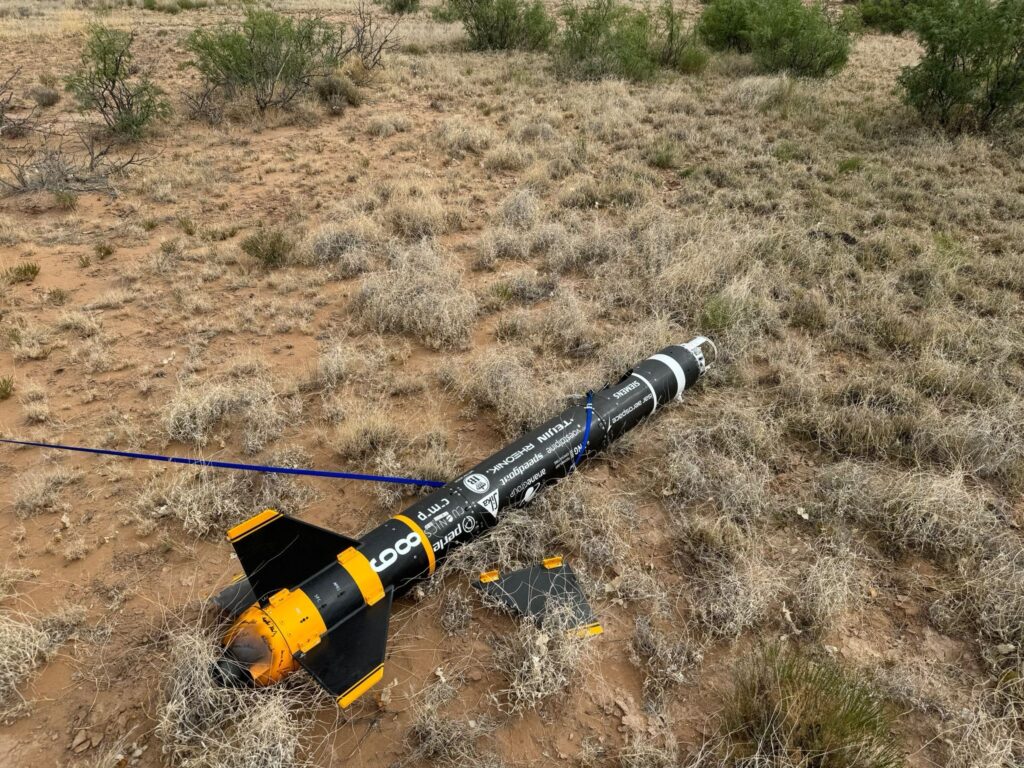
We proudly launched and fully recovered this vehicle at SAC 2024 (Spaceport America Cup) in the desert of New Mexico.
Since our main target is to educate our members within all subjects of rocketry, we are designing, developing, and manufacturing everything from carbon fiber structures, our weight-optimized CNC parts, and our flight computer in-house.
Looking forward, we are working on our next rocket evolution:
EX-1Evo
EX-1Evo aims to further our expertise in new technologies and push the boundaries of velocity and altitude. As the successor to EX-1E, it introduces several key advancements, including hot staging, strain gauges, temperature probes all over the vehicle for detailed structural analysis, load cells in the recovery systems, and a Mach probe for accurate velocity measurements.
The rocket also features aerodynamically optimized fincans to enhance flight stability and improve efficiency. Designed to reach an altitude of 14 km (approximately 45,000 ft), EX-1Evo will represent us in the 45,000 ft category at the IREC 2025 Competition.



| Project Duration | 2025 – today |
| Total Impulse | ~ 1.3 MNs |
| Diameter | 400 mm |
| Engine Cycle | Expander Bleed (Turbopump) |
| Thrust | 15 kN |
| Takeoff mass | ~ 650 kg |
| Apogee target | 150 km |
| Propellant | LCH4 / LOX |
FLP/ODIN
WARR’s Future Launcher Program at BVSR ODIN
Looking forward, we are advancing the next step in our rocket evolution , the Future Launcher Program (FLP), our first liquid-fueled space shot design study within the BVSR ODIN competition.
The vehicle is conceptually designed to cross the Kármán line, provide sustained microgravity, and investigate how student-developed demonstrators could one day evolve into orbital launch systems.
The program builds on WARR’s technology heritage: cryogenic system expertise from Nixus, staging and supersonic flight experience from WESP, and control system research from Retrofire. Together, these foundations support one of our most advanced studies to date.
Within ODIN, FLP serves as our formal competition submission and a framework to evaluate and validate concepts through simulation and system-level analysis. Promising subsystems may later transition into focused hardware development or a follow-on ODIN iteration.
At the heart of the design lies an Methane/LOX turbopump-fed engine in an expander-bleed configuration that’s currently being developed in-house. The vehicle concept also features provisions for active aerodynamic control and a cold gas reaction control system for coast and descent, developed in collaboration with Retrofire.
Past Projects

| Project Duration | 2013 – 2023 |
| Height | 5,8 m |
| Diameter | 240 mm |
| Takeoff Mass | 145 kg |
| Thrust | 10 kN |
| Apogee | 12106 m |
Cryosphere
Project Cryosphere represents the biggest and most powerful rocket WARR ever built.
The rocket utilizes a self-designed and built hybrid rocket engine. It runs on cryogenic liquid oxygen and solid HTPB-Polymer and achieves over 1 t / 10kN of thrust.
After years of development, the rocket finally launched in 2023. It achieved a height of 12 km, which marks the highest altitude WARR Rocketry has ever achieved. It launched from the Mojave Desert in the US at the Friends of Amateur Rocketry launch site.

Sponsors and Partners
Gold


Silver


Bronze


Supporter & Donors


